Collagen Peptides

Structural / Skin

Collagen Peptides

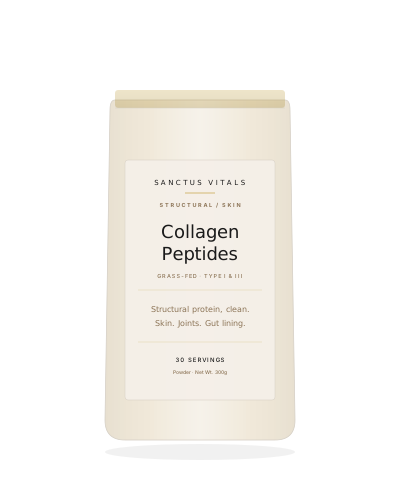
Hydrolysed Type I+III collagen from grass-fed bovine. 10g per serving for skin elasticity, joint cartilage support, gut lining repair, and structural integrity throughout your body.

$58 300g · 30 servings · per pouch
3rd Party Tested Grass-Fed No Fillers Hydrolysed

The protein your body is losing

01

✨ Skin Elasticity & Hydration

After age 25, collagen production declines ~1.5% per year. By 50, you've lost roughly 30% of your dermal collagen. Supplementing with hydrolysed collagen peptides stimulates fibroblasts to produce new collagen, increasing skin elasticity and hydration. Clinical trials show measurable improvement in skin moisture and wrinkle depth within 8 weeks of 10g daily.

02

🦴 Joint & Cartilage Support

Type II collagen makes up 60% of cartilage dry weight. Hydrolysed collagen peptides accumulate in cartilage tissue and stimulate chondrocytes to produce new cartilage matrix. Studies in athletes show reduced exercise-related joint pain and improved joint function with consistent collagen supplementation.

03

🔧 Gut Lining Integrity

The gut lining is collagen-rich tissue that requires constant repair. Collagen provides glycine and proline — two amino acids critical for maintaining the intestinal epithelial barrier. Combined with colostrum for tight junction repair, collagen peptides address gut permeability from the structural protein side.

04

💅 Hair, Nails & Connective Tissue

Collagen is 30% of your body's total protein — it's in your tendons, ligaments, hair, nails, blood vessels, and bones. Supplementation provides the specific amino acid profile (glycine, proline, hydroxyproline) that your body uses to maintain and repair all connective tissue. Stronger nails and thicker hair are often the first visible signs.

Hydrolysed for absorption. Grass-fed source.

Supplement Facts (per 1 scoop / 10g)

Hydrolysed Bovine Collagen Peptides (Type I+III)10,000mg
— Glycine~2,200mg
— Proline~1,300mg
— Hydroxyproline~1,100mg
Other IngredientsNone.

Why Hydrolysed Matters

  • Native collagen molecules are too large to absorb intact through the gut. Hydrolysis breaks collagen into small peptides (2–5 kDa) that are efficiently absorbed into the bloodstream.
  • These peptides are bioactive — they don't just provide amino acids. They signal fibroblasts and chondrocytes to ramp up new collagen production. The peptides themselves are the trigger.
  • Type I (skin, tendons, bone) + Type III (skin, blood vessels, organs) covers the two most abundant collagen types in the human body.
  • Important: Vitamin C is required for collagen synthesis. Ensure adequate vitamin C intake (from food or supplementation) for maximum benefit.

Third-Party Tested. Every Batch.

Every batch is independently tested for amino acid profile verification, heavy metals (lead, mercury, arsenic, cadmium), and microbial contamination. Grass-fed sourcing and molecular weight distribution are verified. COA available on request.

How to use it

Recommended Protocol

Dose: 1 scoop (10g) daily

Timing: Morning or any time — dissolves in hot or cold liquids. Coffee, smoothies, oats, or plain water.

  • Unflavoured and virtually tasteless. Dissolves completely without affecting the taste of your drink.
  • Ensure adequate vitamin C intake — collagen synthesis requires vitamin C as a cofactor. A piece of fruit or a small supplement is sufficient.
  • Consistent daily use for 8–12 weeks before expecting visible skin and joint improvements. Nail/hair changes often appear within 4–6 weeks.

Stack Suggestions

  • Colostrum — Colostrum repairs tight junctions, collagen provides structural protein. The complete gut restoration protocol — repair + rebuild.
  • NAC — Glutathione protects collagen from oxidative degradation. NAC for antioxidant defence + collagen for structural repair.

The science

Collagen is the most abundant protein in the human body, comprising approximately 30% of total protein content. It forms the structural scaffolding of skin, bones, tendons, ligaments, blood vessels, and the gut lining. Type I collagen (the most abundant) provides tensile strength to skin and bone, while Type III supports skin elasticity, blood vessel integrity, and organ structure. After age 25, endogenous collagen production declines at roughly 1–1.5% per year, leading to the progressive degradation of skin elasticity, joint cartilage, and connective tissue integrity that characterises ageing.

Hydrolysed collagen peptides are enzymatically broken down into small fragments (typically 2–5 kilodaltons) that are efficiently absorbed through the intestinal wall. Crucially, these peptides don't just serve as amino acid building blocks — they function as signalling molecules. Hydroxyproline-containing dipeptides (like Pro-Hyp and Hyp-Gly) accumulate in the bloodstream and in target tissues, where they stimulate fibroblasts (in skin) and chondrocytes (in cartilage) to increase collagen and hyaluronic acid production. This bioactive signalling effect is what distinguishes hydrolysed collagen from simply eating protein.

Clinical evidence is substantial. A meta-analysis of 19 randomised controlled trials found that collagen peptide supplementation significantly improved skin hydration and elasticity compared to placebo. Joint studies in athletes show reduced exercise-related pain and improved functional outcomes. The amino acid profile of collagen is uniquely rich in glycine (33%), proline (13%), and hydroxyproline (10%) — amino acids that are underrepresented in modern diets and specifically required for collagen synthesis. One critical cofactor is vitamin C, which is essential for the hydroxylation of proline and lysine residues during collagen formation. Without adequate vitamin C, collagen synthesis is impaired regardless of peptide intake.
Sourcing & quality

Grass-Fed Bovine

Sourced from grass-fed, pasture-raised cattle. The collagen is extracted from bovine hides using enzymatic hydrolysis — no chemical solvents. The quality of the source animal directly impacts the amino acid profile of the final product.

Optimised Hydrolysis

Enzymatically hydrolysed to a molecular weight of 2–5 kDa for maximum absorption. This is the sweet spot — small enough for gut absorption, large enough to retain bioactive peptide sequences that signal collagen production in target tissues.

Manufacturing Standards

GMP-certified facility. Every batch is third-party tested for amino acid profile, molecular weight distribution, heavy metals, and microbial limits. Unflavoured, unsweetened, no additives. Full COA available.

What people are saying

James R.✓ Verified Purchase

My wife noticed my skin before I did — said it looked "healthier and more hydrated" after about 6 weeks. My nails are noticeably stronger and my knee that always ached after running is significantly better. 10g in my morning coffee, can't taste it at all.

Tom B.✓ Verified Purchase

Dissolves perfectly in hot coffee with zero taste impact. That's the baseline — but the results after 8 weeks are what keep me buying. Joint mobility during squats is better, skin looks tighter, and the fine lines around my eyes are less prominent. Simple, effective product.

Nick H.✓ Verified Purchase

Stacking collagen + colostrum as a gut repair protocol after years of NSAID use. Three months in, my bloating is almost completely gone, food sensitivities have reduced, and my digestion feels smoother than it has in years. The combination is powerful.

Mark L.✓ Verified Purchase

I'm 40 and taking this proactively for joint and skin health. Grass-fed bovine source, no additives, third-party tested — it ticks every box. Hair is thicker, nails don't peel anymore, and my physio noted improved tissue quality in my Achilles tendon. Solid product.

Common questions

Collagen has a unique amino acid profile — rich in glycine, proline, and hydroxyproline — that regular protein powders (whey, casein, plant) lack. These specific amino acids are the building blocks for collagen synthesis. Plus, hydrolysed collagen peptides act as signalling molecules that trigger your cells to produce more collagen. Whey protein doesn't do this.
Yes — vitamin C is an essential cofactor for collagen synthesis. It's required for the hydroxylation of proline and lysine, a critical step in forming stable collagen fibres. You don't need a supplement if you eat fruit and vegetables daily, but if your diet is low in vitamin C, adding a small supplement (100–250mg) alongside collagen will significantly improve outcomes.
Nail and hair changes are usually noticed first — within 4–6 weeks. Skin hydration and elasticity improvements typically become visible at 8–12 weeks of consistent use. Joint improvements follow a similar 8–12 week timeline. Collagen turnover in skin is slow, so patience and daily consistency are essential.
Yes. Hydrolysed collagen peptides are heat-stable — the hydrolysis process has already broken down the protein structure, so coffee temperature won't damage the peptides further. It dissolves completely in hot liquids without affecting taste or texture.

You might also like

Collagen Peptides$58